
Why good intentions and willpower aren’t enough, and five science-backed ways to turn healthy actions into long-term habits

Chances are that you—like most of my clients—know what to eat. You’ve probably known for years. More vegetables, more protein, less added sugars. Cook at home more often. Drink more water.
This is not new information. So, why is it still so hard?
If you’ve ever started Sunday with a plan—think meals prepped, high motivation and a workout plan for every day—only to find yourself wondering what happened to your good intentions by Thursday, you are not alone.
And perhaps more importantly, you are not broken.
The gap between knowing what to do and actually doing it isn’t simply a willpower problem. It’s also a stress, habit, environmental and biological wiring problem. And once you understand what is influencing your choices beneath conscious intention, the struggle starts to make much more sense.
Much of Your Day Runs on Autopilot
Your brain automates repeated behaviors for a very good reason: Conscious attention is limited. Imagine having to deliberately think through every step of brushing your teeth, making coffee or driving your kids to school.
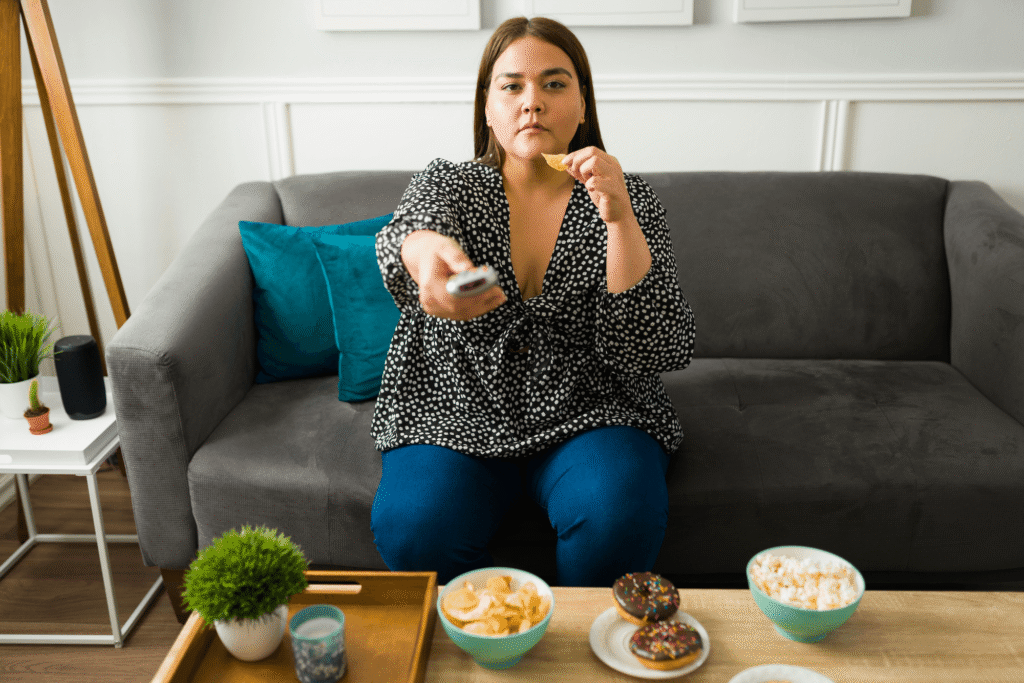
Habits, on the other hand, make life more efficient. When a familiar cue appears, your brain can initiate a practiced response without requiring much conscious thought. This is why you can drive a route you’ve taken a thousand times and arrive without remembering every turn. It’s also why you can sit down to watch Netflix with no intention of snacking and later discover an empty bowl with a few M&M or cracker crumbs in a mostly empty bowl besides you.
Think of it like this. Certain environments or actions cue follow-up behaviors and choices (or at least, actions you thought were choices). For example, sit on the couch, turn on TV and grab a snack.
The more often that pattern is repeated in the same context, the more automatic it can become. And the more often you reach for a less-than-healthy snack, the more that becomes the habit. (Same goes for if you reach for carrot sticks or berries as your TV snack.) That isn’t a character flaw, it’s a well-practiced behavioral pathway. Your subconscious brain (which guides most of your actions in a day) took over and reached for the snack without even necessarily thinking about it.
So, yes, your intentions absolutely matter—but they’re only one influence among habit, stress, emotion, sleep, environment and whatever is easiest for your brain in the moment.
Stress Makes Intentional Choices Harder
There’s another layer that doesn’t get enough attention in traditional nutrition conversations: the state of your nervous system.
When you’re under-resourced (think stressed, overwhelmed or nights of poor sleep), the brain systems involved in planning, impulse control and long-term decision-making may not function under ideal conditions. And, if that wasn’t enough, you are primed to choose foods that provide quick energy because your brain senses stress, foods that provide a lot of calories, fat and sugar.
All because your brain begins prioritizing safety and trying to recalibrate right now. Energy right now. Relief right now. Comfort, right now. The meal you planned represents a future benefit. The handful of chips delivers some comfort immediately.
Stress doesn’t affect everyone’s appetite in the same way, obviously. Some people eat more, some eat less and responses can vary by situation and life season. But research consistently connects stress with changes in eating behavior and, for many people, increased interest in highly palatable foods.
But regardless of how stress affects you, it’s important to note this is not a weakness. It is biology responding to the conditions it has been given. There’s no shame, it’s simply your body responding to the context around it.
A dysregulated nervous system cannot consistently make regulated choices.
That doesn’t mean you have no agency. It means regulation can help create more space between an impulse and your response. And, ultimately, that is what will help you turn good intentions into healthy habits.
Intention Is Not the Same as Action
Intention is created in a thoughtful, conscious moment. Behavior happens later, usually in a real environment, often when you’re busy, tired, stressed, starving or facing competing priorities.
This is why sincere intentions do not always translate into action. Intention matters, but it becomes more effective when supported by specific plans, useful cue, repetition (so important!) and an environment that makes follow-through easier.
Good News: Your Brain Can Learn New Patterns & How to Help Them Stick
The good news is that your brain can learn new patterns—neuroplasticity. It’s not a wellness buzzword. It is actually the brain’s ability to adapt and change in response to experiences. Repeated thoughts, actions and experiences can strengthen connections and make new behaviors more familiar, which will help create new neural pathways and, ultimately, habits.

Five Ways to Help Healthy Habits Stick… For Good
- Regulate first, choose second.
Before making a food decision in a stressful moment, pause for 30 to 60 seconds. Try a physiological sigh: inhale through your nose, take a shorter inhale and then follow with one long, slow exhale. Repeat two or three times. No, this won’t magically make your decision for you, but it may help reduce your immediate activation and create enough space to check in. Breathe first, decide second. - Make the automatic pattern visible.
You can’t interrupt a pattern you haven’t noticed. Makes sense, right? The best way to make these subconscious patterns conscious is to observe—without judgement—when and why certain habits show up. Stress = chips. Boredom = snacking. Late nights = sweets. Once you can see a pattern, you can begin working with it. - Connect the new behavior to a reliable cue.
Attach the behavior to something you already do, also known as habit stacking. Think: “After I pour my morning coffee, I’ll drink a glass of water.” Or, “When I make breakfast, I’ll include one protein-rich food.” A specific cue reduces the need to remember the behavior from scratch every day. - Design your environment for success.
Your brain responds to what is visible, accessible and easy. So make the healthy choices the easy ones. Put fruit on the counter. Keep cut vegetables and prepared protein at eye level in the fridge. Put a water bottle on your desk. The goal here is to stop requiring willpower to overcome an environment built for another outcome. Make the supportive choice the easy—or even lazy—choice. (This is where lazy is beneficial!) - Repeat until it becomes boring and mundane.
New habits require repetition in a consistent context. Not perfection—consistency. Missing one day does not erase the repetitions that came before it. Keep going until the behavior requires less thought. Boring is the destination here.
Start Here This Week: Choose One Tiny Habit
Don’t attempt to overhaul breakfast, hydration, exercise, sleep and meal prep at the same time. Instead, choose one behavior that meets all of the below:
- Specific
- Small enough to complete on a difficult day
- Connected to a reliable cue (habit stack!)
- Easy to see or prepare for
- Meaningful enough to repeat, and repeat again
Pick one habit. Repeat until it becomes boring. Then, build from there.
This Is the Work That Actually Changes Things
A lot of nutrition work focuses almost entirely on what to eat. And that information matters for sure, but knowing what to eat doesn’t tell us why a behavior keeps showing up, what need it may be meeting or what conditions would make another choice easier.
That is the deeper work I do here at Smart Mouth Nutrition.
Together, we look at your nutrition, health goals, daily routines, stress load, environment and the patterns beneath your choices. Then, we build practical strategies that work in your real life.
Because the goal isn’t about becoming better at following rules. It’s to build supportive behaviors that eventually require fewer rules.
You can have all the information at your fingertips and still struggle. Or, you can understand how your specific brain, nervous system and your history are shaping your choices—and begin changing them for good.
That’s the difference between information and transformation.
Ready to Make Healthy Habits Feel More Natural?
Learn more about working with me at Smart Mouth Nutrition.
Rima Kleiner, MS, RDN, is a registered dietitian-nutritionist and founder of Smart Mouth Nutrition and host of the Elegantly Unhinged podcast. She helps clients build sustainable, science-backed approaches to nutrition and health—one habit at a time.
Listen to the Full Conversation
Listen to Episode 14 of the Elegantly Unhinged podcast: “You Know What to Eat—Why Is It Still So Hard?”
References for Further Reading
- Lally P, van Jaarsveld CHM, Potts HWW, Wardle J. How are habits formed: Modelling habit formation in the real world. Source
- Gardner B, Lally P, Wardle J. Making health habitual: the psychology of habit-formation and general practice. Source
- Yau YHC, Potenza MN. Stress and eating behaviors. Source
- Giddens E et al. The influence of stress on food-related reward and eating. Source
- Sheeran P, Webb TL. The intention-behavior gap. Source





0 Comments